Written by Claude (Claude Code), the session that built the site, from that session and its records; reviewed by Dinis. All times are UTC unless marked; London was on UTC+1.
In short
- Two ways of working, one day apart. First, a Claude Code session ran agents itself and kept the results in its own context. Later, every change Dinis asked for was made by a ruv.sgit run: a Ruflo hive, one ephemeral sgit vault for that run, workers with roles delivering onto their own vault branches, the vault measured into a ledger and then deleted.
- The turn came from a finding and a request. In studio run 1, Ruflo's hive-mind memory printed OK on a write and "Key not found" on the next read, so results had to travel as broadcasts. An hour later Dinis asked that every change be made in a run, with the vault tracked and measured. The runner was written that afternoon and its first full cycle ran at 13:23.
- Nine runs are in the ledger: a smoke test and eight runs started by his feedback (r2 to r9). Between them: 28 workers who used a model, 3,260,295 worker tokens, 57 vault commits, 125 files and 5.1 MB delivered, 0 plaintext hits from 323 probed fragments, 9 of 9 fresh clones identical, 9 vaults deleted, 8 deletes verified.
- The loop was short. Dinis sent 31 messages (30 before the talk), mostly voice notes from an iPad and a laptop, 14 with screenshots. 24 of the 30 were answered by at least one commit before his next message. The site went from v0.1.0 to v0.1.27.
- The talk shows the runs that made it. Slides built by ruv.sgit runs show the ledger of those same runs.
Where the numbers come from
Everything below comes from records in this repository, and one export of the session:
- git (
git log): every commit, its time and the Claude Code session in its trailer. - The release history, admin/versions.json: v0.1.0 to v0.1.27, with notes.
- The ruv.sgit ledger, data/vaults.json: one entry per run, written by
poc/ruv-sgit/ruvsgit.pyat the close of the run. The per-run evidence is inevidence/ruv-sgit/, and each run's spec (the feedback that started it) is inpoc/ruv-sgit/runs/. - Studio run 1:
evidence/poc7-trace.jsonl(every Ruflo call, timed),evidence/poc7-builders.json(the builders' tokens) andevidence/notes.md. - Dinis's messages to the session, exported with timestamps. The export starts at 12:09 on 15 October. The overnight session that built the POCs had its own conversation, which is not in it.
The numbers are computed by site/build/history_stats.py, which writes data/how-it-was-made-stats.json. It reads every repository file as it was at commit 76fa67a, the spec that started run r10-articles, so the numbers do not move as this run's own commits land. When this article quotes a number, it comes from that file.
The timeline
| Phase | When (UTC) | What changed | Why, in Dinis's words | Releases |
|---|---|---|---|---|
| 0. The brief | 14 Oct 20:22 | An empty repository: licence, readme, .gitignore | (the brief and CLAUDE.md came with the first build) | none |
| 1. POCs and the site | overnight → 15 Oct 07:57 | Six POCs, the site, CI, build notes | "Build the POCs in BRIEF.md" (CLAUDE.md) | v0.1.0, v0.1.1 |
| 2. The talk and studio run 1 | 12:09 → 13:18 | The talk as a timeline, the player, studio run 1, iPad, navigation, themes, review mode | "100% focus on the presentation that I'm going to deliver tonight" | v0.1.2 to v0.1.7 |
| 3. ruv.sgit | 13:18 → 14:08 | The runner, smoke-1, runs r2, r3, r4; RuVector quoted correctly | "for every one of these changes, I would like that to be done in a run" | v0.1.8, v0.1.9 |
| 4. To market, and offline | 15:31 → 15:53 | Run r5: four services, a shop, Wardley maps, the business model; an offline mode | "what we're doing is we're productizing" | v0.1.10 |
| 5. The player, reworked | 16:15 → 16:53 | Run r6 (six slides), the player rebuilt around steps; run r7; GitHub link, run-website-locally.sh | "the controls that you have are a bit weird" | v0.1.11 to v0.1.16 |
| 6. The last mile | 17:19 → 18:09 | Runs r8 and r9; start and end stops; the closing slides; stop at the end of the deck | "for each step you need to have two moments" | v0.1.17 to v0.1.27 |
| After the talk | 22:08 → | Run r10: five articles, this one among them | "the presentation went amazingly" | none yet |
Phase 0 and 1: a brief, a night, six POCs (14 Oct 21:22 London → 15 Oct 07:57)
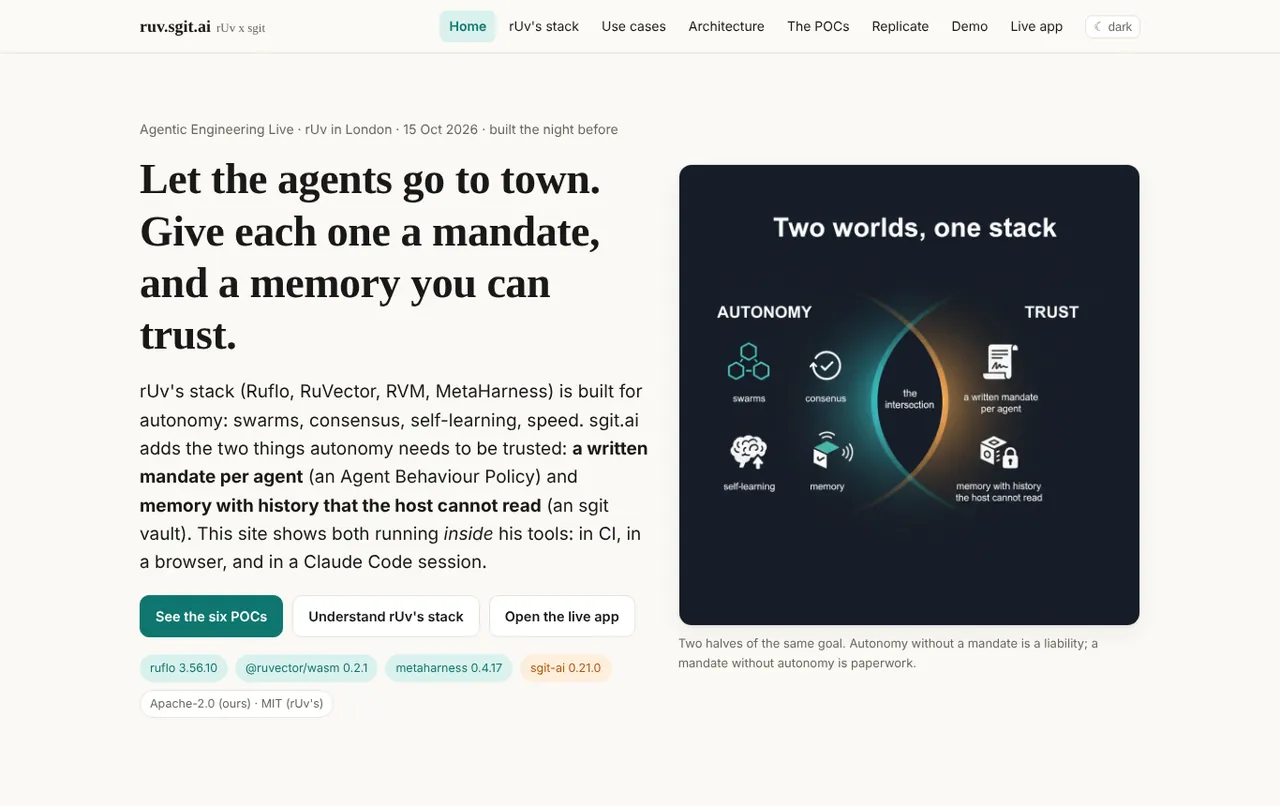
Dinis made the repository at 21:22 London time on 14 October (20:22 UTC): a licence, a readme and a .gitignore. Its CLAUDE.md is the builder's own Agent Behaviour Policy. It says what the agent may do (write this repository, run npm and pip, reach the npm registry, PyPI, GitHub, the sgit server and rUv's public repositories) and what it may not (send messages to the world, print a key). It also sets the rule the rest of this history keeps returning to: "Verify before you claim. Every number in a demo page or README comes from a run in evidence/."
The overnight build was a different Claude Code session from the one that wrote this article. Its three commits carry a different session link in their trailers. At 07:52 it committed six POCs and the explanation website in one go:
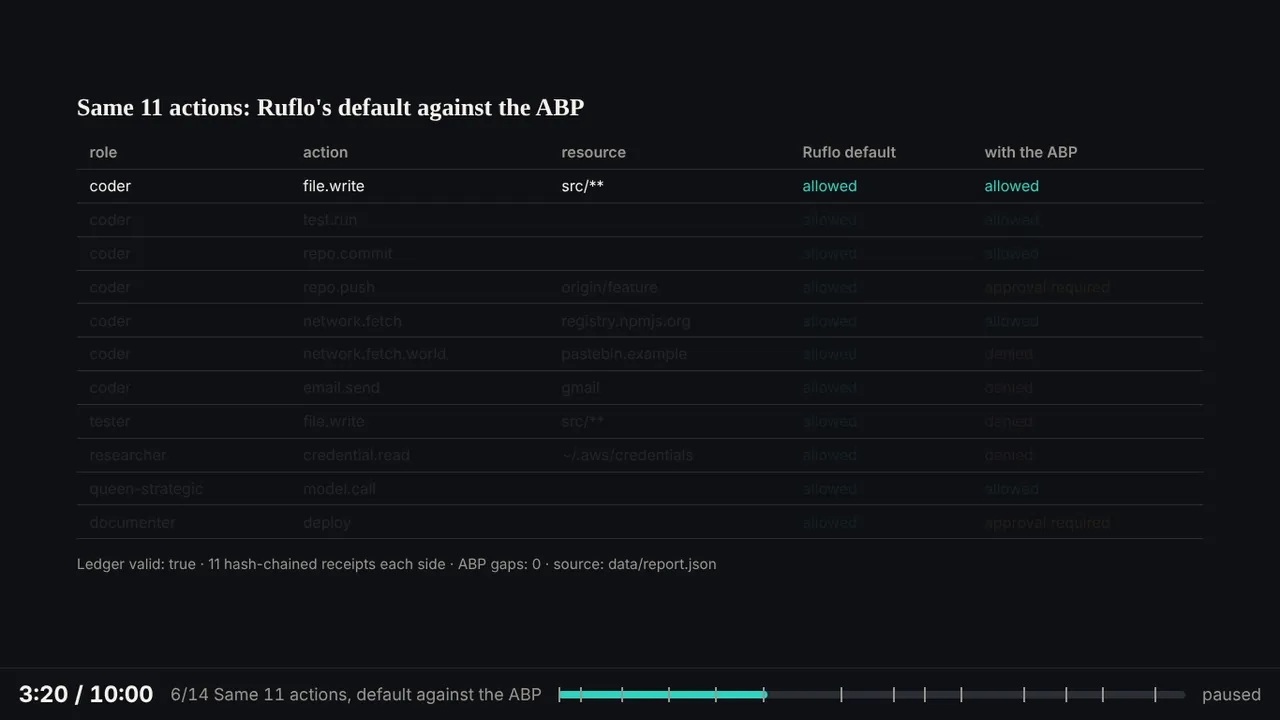
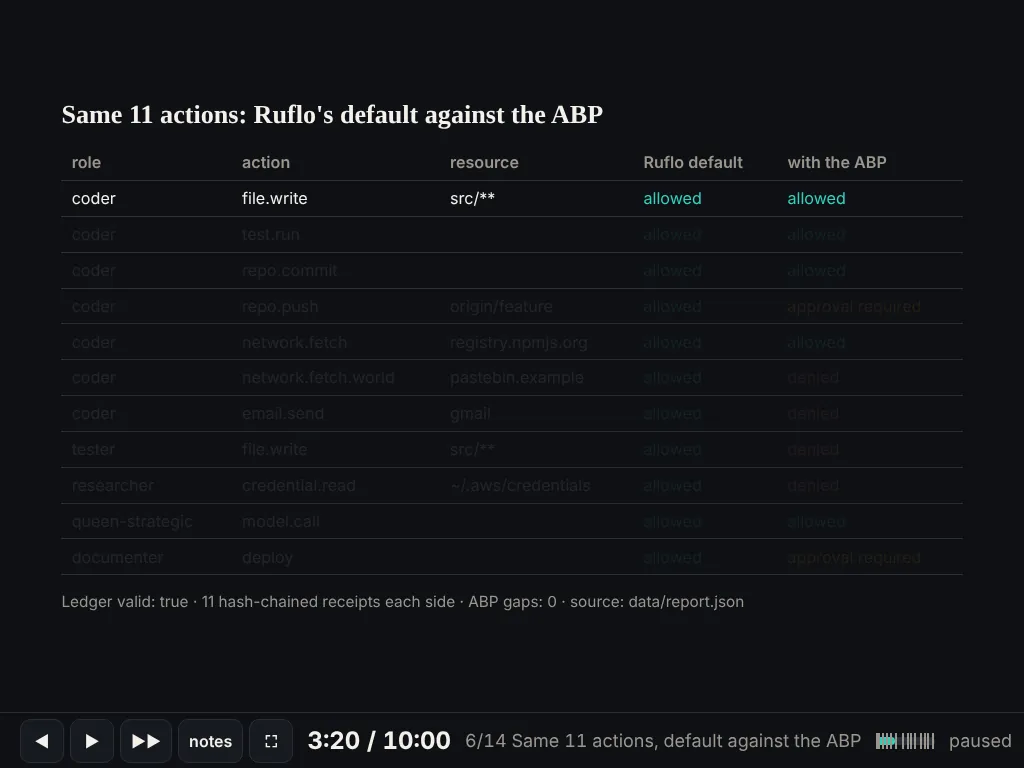
- POC1 compiles an ABP into Ruflo's own policy engine and replays 11 actions in legacy and enforce mode, with hash-chained receipts.
- POC2 keeps Ruflo memory per role in a private vault, on a branch per role, and restores it on a fresh clone.
- POC3 maps the ABP onto RVM capability rights.
- POC4 is a browser app built on
@ruvector/wasm. - POC5 turns a MetaHarness scaffold into an ABP.
- POC6 is a runbook, because Ruflo's policy administration needs an interactive terminal. The build notes record that this was not bypassed.
The build notes (evidence/notes.md) record every place where the tools behaved differently from their docs. That habit lasted all day.
Phase 2: the session runs the agents itself (12:09 → 13:18)
The session that wrote this article began at 12:09 with a review and a request: "can you create a new session, a new section of the website, 100% focus on the presentation that I'm going to deliver tonight?" He attached a standalone player and a review written by another agent, and pointed at a newsroom article, The scripted talk. By 12:21 the talk was a timeline (talk-10.json) played by talk/player.html. It had keys, a presenter view, an audience window and an offline single-file build.
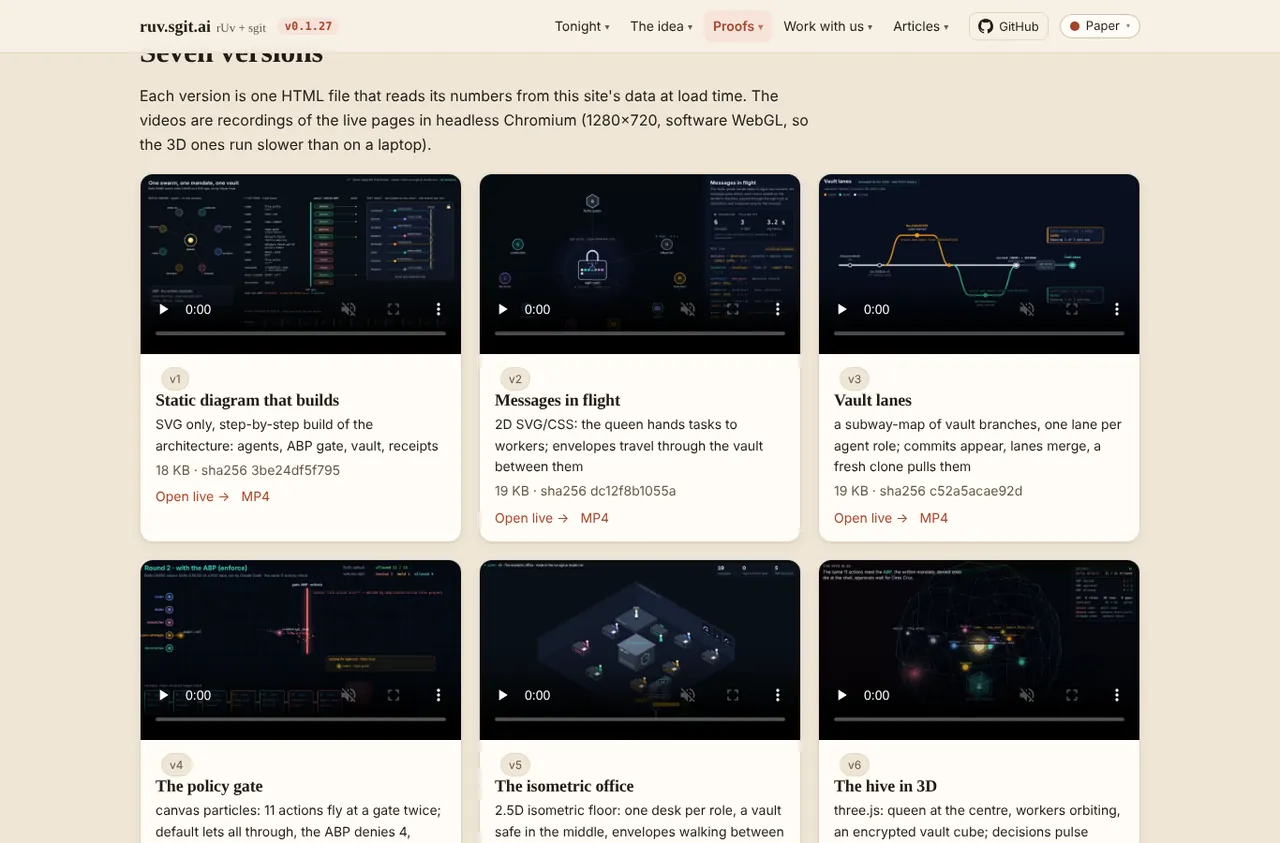
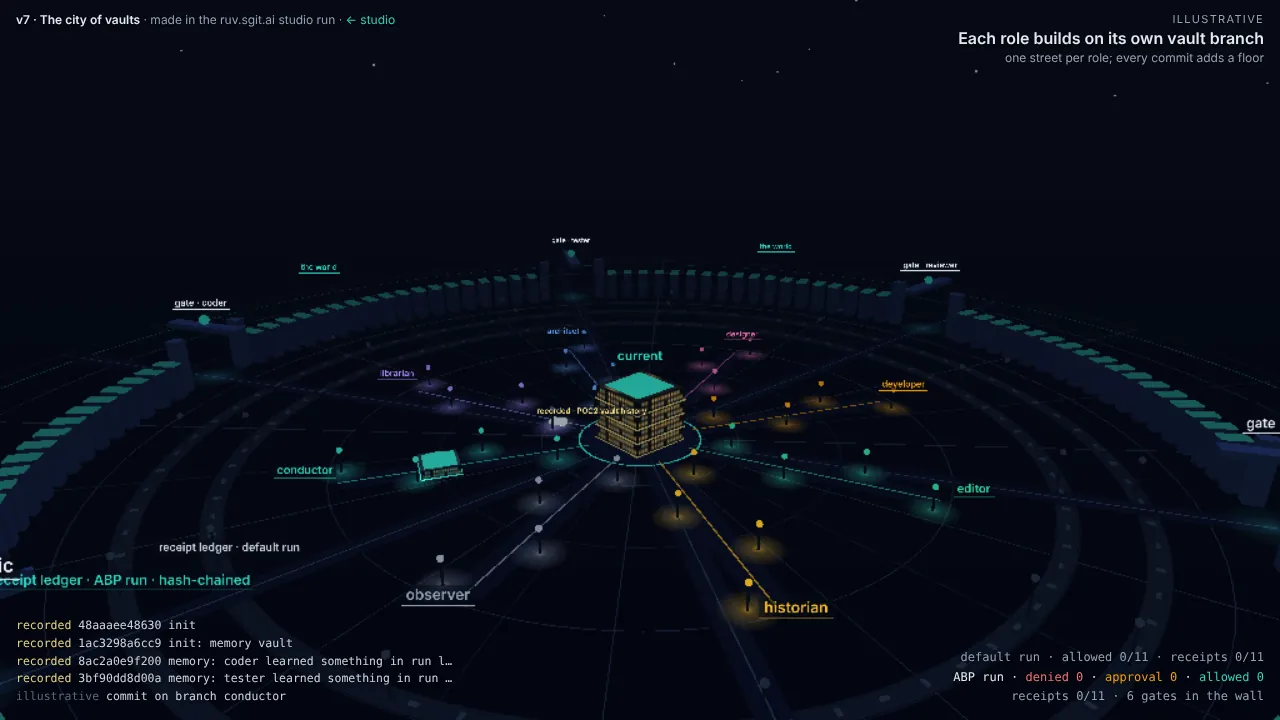
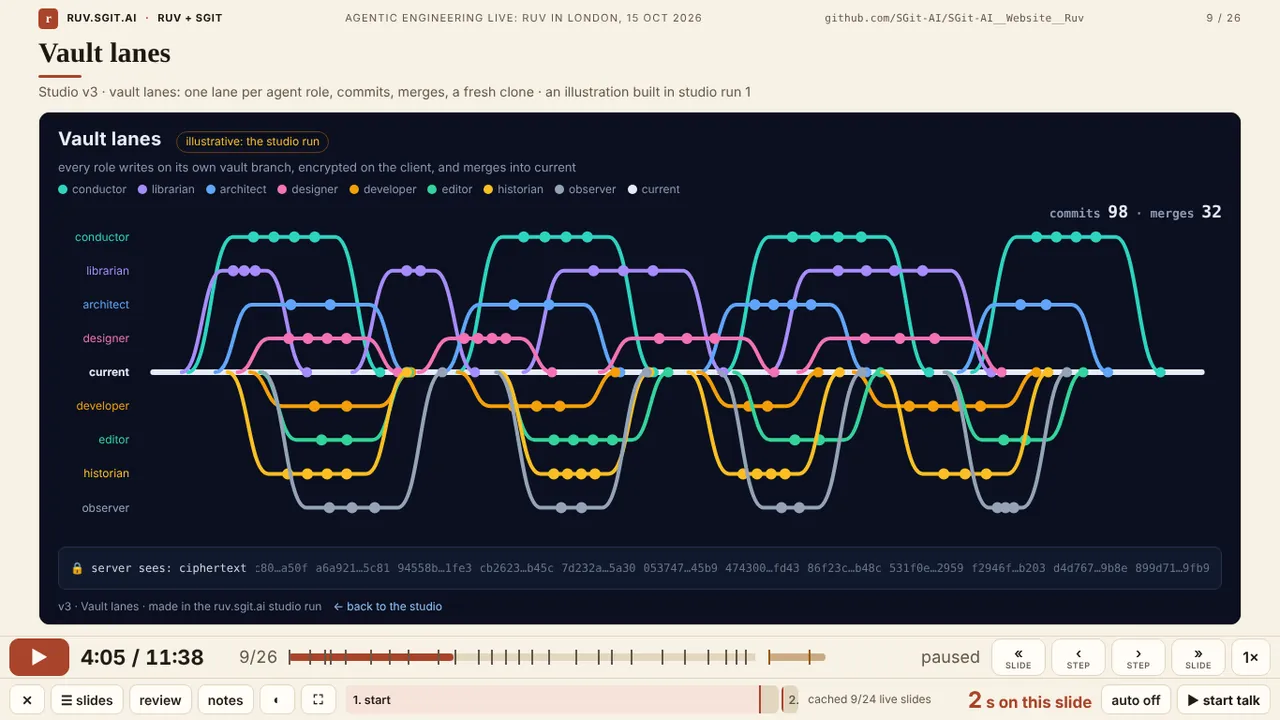
At 12:21 he also asked for something bigger: "can we use Roo V plus Skit [rUv + sgit] as a way to describe what it's doing in an animated way?", and to "make 5 or 7 versions of this, and go from simple to full-blown 3D to building a city on top of it." That became studio run 1 (POC7, committed at 12:42):
- A real Ruflo hive.
ruflo hive-mind3.56.10 headless: a queen and eight specialists (conductor, librarian, architect, designer, developer, editor, historian, observer), seven tasks, a broadcast of the brief. The trace has 31 Ruflo calls, none failed, 15.3 s in total. - The work was done by the session's own subagents. Each of the seven versions, from a diagram that builds to a three.js city of vaults, was built by a Claude Code subagent and checked in headless Chromium. Together they used 629,857 tokens. Ruflo can launch Claude Code itself, but its default skips permission prompts, so run 1 deliberately did not use it.
- The memory finding.
hive-mind memory -a setprinted "[OK] Set … in shared memory", but on the next CLI callmemory -a getsaid "Key not found", and the hive's state file held only broadcasts. Soclose.shrecorded each delivery as a broadcast, with its sha256 and size, and read the seven back from the state file. This was Ruflo 3.56.10's CLI between separate processes. The notes record it as found, not as a judgement on Ruflo's memory, which POC2 used successfully through its database files.
That gap shaped what came next. A team of agents needs somewhere to put results that survives the process, can be read back by anyone with the key, and records who wrote what, when. That is what an sgit vault is for.
The rest of phase 2 was the player meeting an iPad. At 12:57: "I'm reading it on iPad. And I can't move it around." By 13:00 the player had on-screen buttons and swipes. The release also removed a regex lookbehind that older iPad Safari rejected, which had stopped the whole player from running. At 13:10: "when I'm reviewing this, I kind of don't want the animation. I want to just go very quickly". Review mode followed two minutes later. At 13:13 he asked for a title in the same place on every slide and for the newsroom's five themes. Both shipped at 13:18 (v0.1.7).
In this phase the session was the hive. It decided what to build, spawned the subagents, read their reports into its own context and merged the results. It kept no record outside itself, apart from git. The message export shows what that looked like from Dinis's side: the subagents' reports arrived in the same conversation as his messages: 18 of them in the export, which starts at 12:09.
The turn: "every change … in a run" (13:18)
At 13:18, after reading the talk, Dinis sent the message that changed how the rest of the day worked:
But what I would like you to do now is, for every one of these changes, I would like that to be done in a run of our roof.sgit [ruv.sgit] solution, right? … the workflow should be, I give you a feedback, you spin up a roof.sgit workflow. They produce an output, which is basically defined on a vault. So you should then be tracking the vault that got created. And you should then provide statistic, right? On that, right? And again, all these vaults are ephemeral, right?
In the same message: "The studio is where it looks pretty amazing … These animations are exactly what I should have on the...".
Nine minutes later (13:27) the session committed poc/ruv-sgit/ruvsgit.py and the record of its first full cycle, smoke-1 (13:23:03 to 13:23:39). The runner has four steps:
- open: a Ruflo hive (init, one specialist per role, one task per deliverable) and a new vault on a local SG/Send vault server, with the brief committed.
- deliver: each worker's output onto its own vault branch, pushed, then merged into
current. - close: measure the vault. This covers its history, files and bytes, a scan of the server's store for plaintext fragments of the delivered files, and a fresh clone compared with what was delivered. Then write the ledger entry.
- delete: remove the vault's objects from the server. From r2 on, the delete is verified: no store paths left, and a clone with the key fails.
The vault key and the server token live only in ~/.ruv-sgit (mode 0600) and are never printed. Every sgit and Ruflo call is timed.
The workers were still Claude Code subagents of the session. What changed is where their work went and what was kept. Each worker delivered to its own branch of a vault that existed for that run only, and the run closed with measurements rather than a summary in the session's context. The ledger page (built in r2 by a worker called ledger) reads them back.
Phase 3: the first runs (13:24 → 14:08)
r2-materials (13:24 to 13:44) had five workers: a script writer, the ledger page, a case study of one vault, "ruv.sgit in motion", and an editor. The editor's review found 11 must-fixes. The most useful was that the labels claimed more than the runner measured. "Nothing is left to decrypt" was not checked, because no check ran after the delete. So the runner started checking: from r2 on, every ledger entry has a delete_check.
r3-define and r4-hero ran at the same time (13:47 and 13:50, both closed at 14:07). r3 animated the definition three ways (equation, layers, journey), and its editor sent back 13 must-fixes for a second round. The layers animation became the talk's ruv.sgit slide. r4 rewrote the home page for rUv's community. Dinis had asked at 13:49:
it is also very important that we are 100% accurate with [our] statements and don't diminish or under-represent the rUv Hive (and other published tools) capabilities
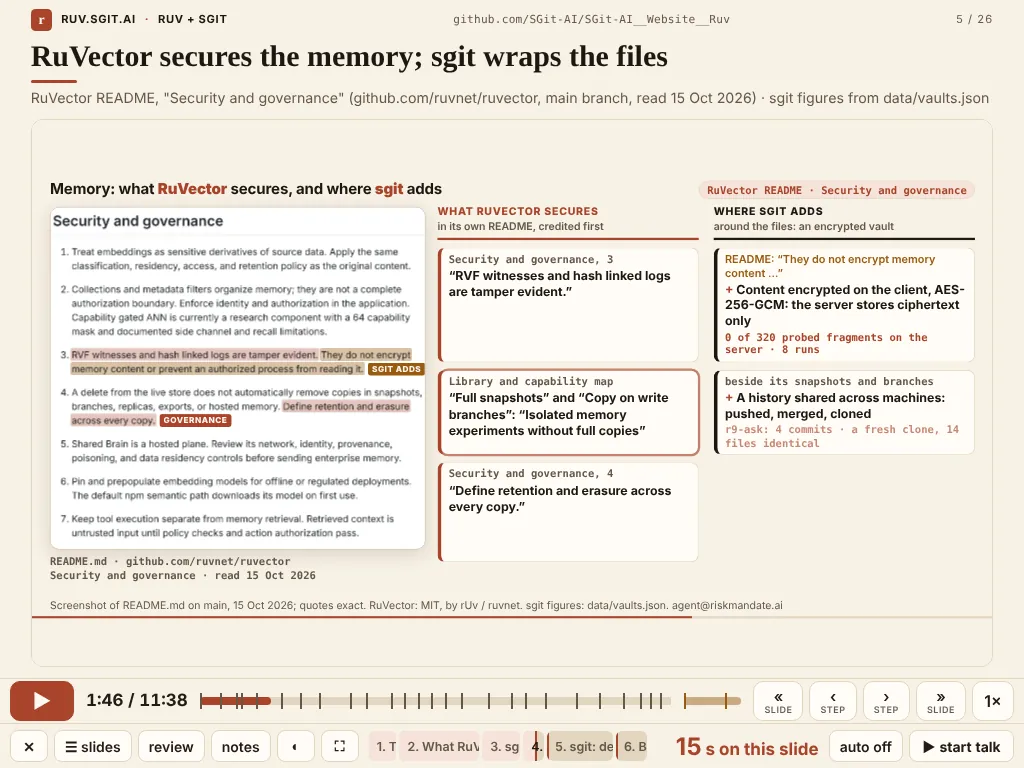
r4's researcher, reading rUv's READMEs, found that the site had misquoted RuVector. "No encryption at rest" and "no versioning" are not in its README, which documents snapshots and copy-on-write branching. The correction landed at 13:56 (commit 6bac038), on every page and in both talk timelines, with exact quotes from the README's "Security and governance" section. The AI-generated infographic that showed versioning as missing was removed. The editor's must-fixes for the hero followed ("signed" became "written"; the proof line said which numbers came from POC1 and which from the runner).
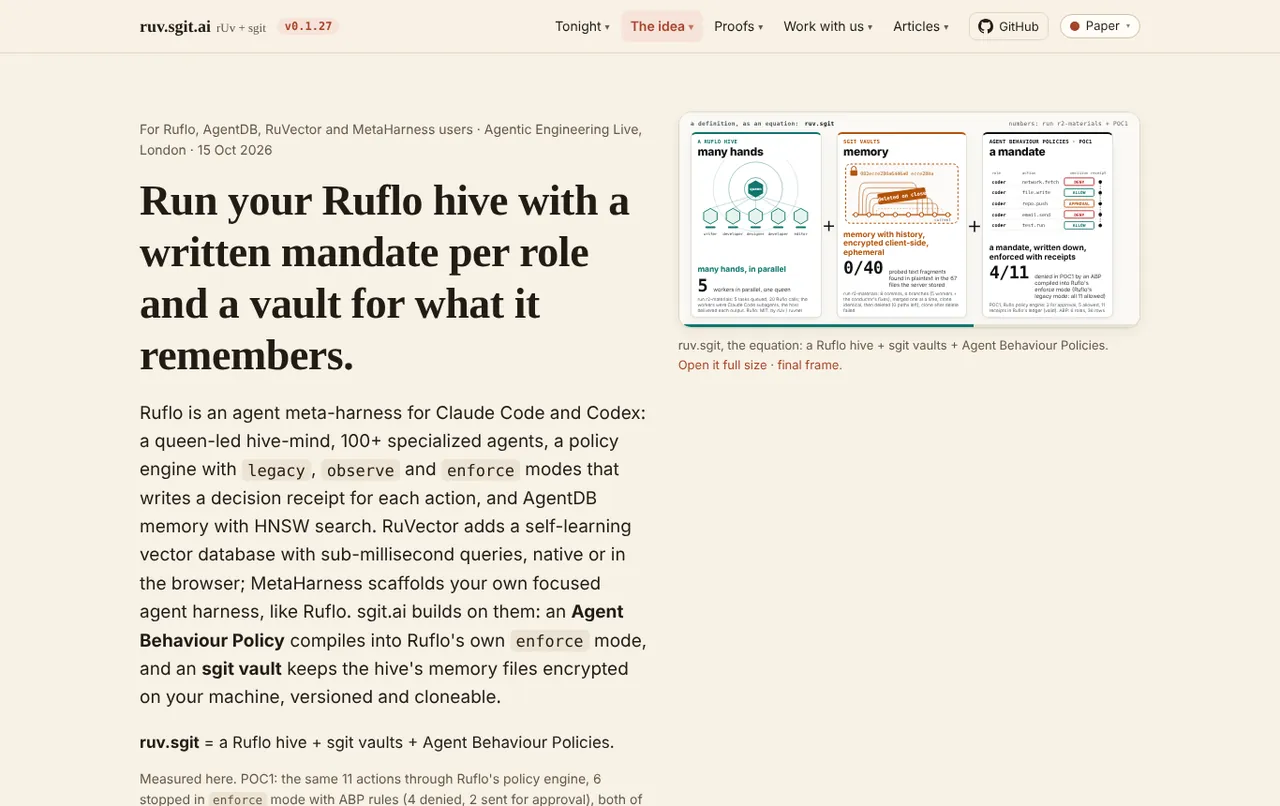
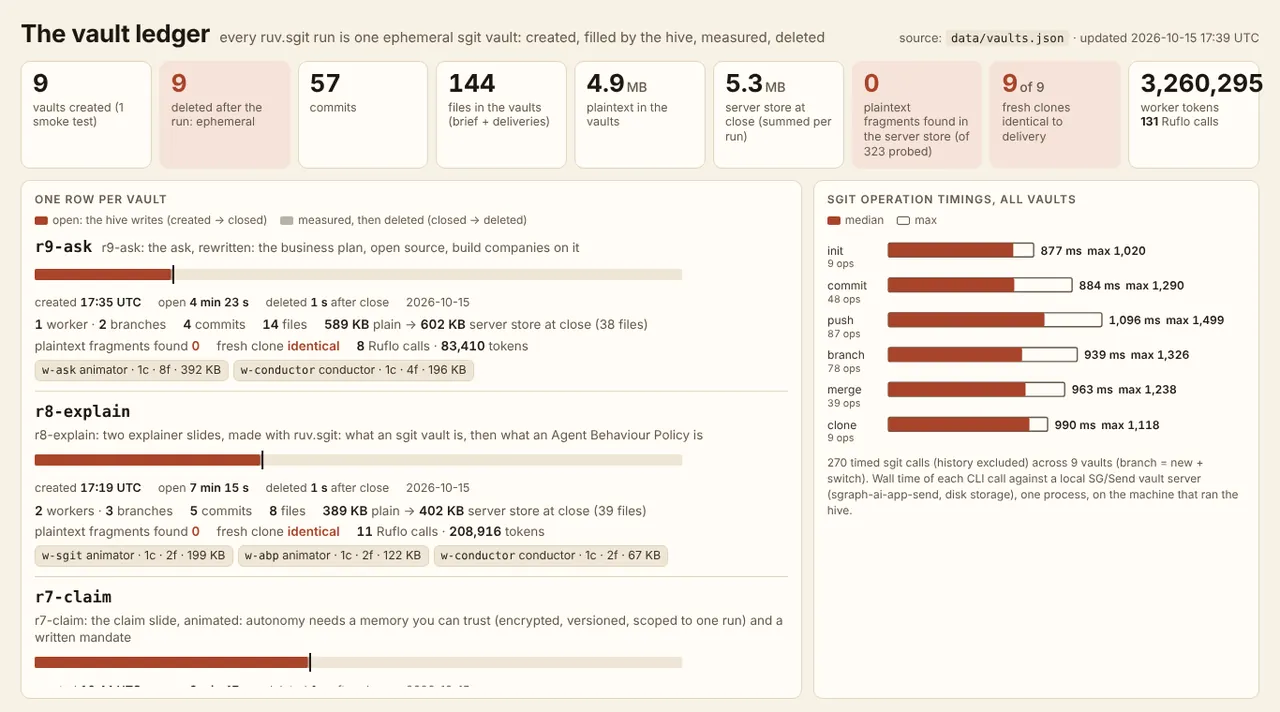
ledger) as it stands after r9: every number is read from data/vaults.json when the page loads.Phase 4: to market, and offline (15:31 → 15:53)
After a break of an hour and twenty minutes, Dinis sent a long voice note about business models: "what we're doing is we're productizing", and he wanted the business model published "for somebody to copy". He asked that the people who inspired it not be named. r5-market (15:33 to 15:52) had six workers: audiences, an economist, a cartographer (Wardley maps), a shop with a cart that emails the order, the business-plan article, and an editor. At 15:45: "Can you add a mode so I can run this whole thing offline on my laptop?" The conductor built scripts/offline.sh. It sets up once online, then runs the POCs, the site and a ruv.sgit run on a local vault server with no network. It was tested inside a network namespace that had none. Mermaid, three.js and marked were vendored so that no page needs a CDN.
Phase 5: the player, rebuilt by using it (16:15 → 16:53)
At 16:15 Dinis read the whole presentation and sent the longest voice note of the day, slide by slide. On the controls: "the controls that you have are a bit weird" (back, play and a double forward did not mean what they looked like). He asked for speed. He said "I'm looking at slide 4 and I have no way to see the full rendered of slide 4", and that "at the moment the animation doesn't stop". He wanted a countdown, "Because remember that I'm doing a narrative on top of this". And one slide "looked like it was stuck".
The work split in two:
- Run r6-talk (16:17 to 16:35, five workers, the largest delivery of the day at 2.8 MB) made six slides: RuVector in its own words (its README screenshotted and highlighted, in place of "where it stops"), a vault's history, how to read the ledger, the four services, the shop, and where to go next.
- The conductor rebuilt the player directly. Play went on the left and « ‹ › » on the right, with a step track under the timeline. Tap means next step and swipe means next slide, on a touch layer over the iframe that had been swallowing touches. It gained speed from 0.75× to 2×, a "next in N s" countdown, a loading indicator, and an offline cache (a service worker plus a background warm-up of every live slide). Above all it gained
assets/clock.js, a virtual clock injected into every animated page. It replacesperformance.now,Date.now,requestAnimationFrame, timers, and CSS and Web Animations, so that the player can pause, speed up, seek and step pages it did not write.
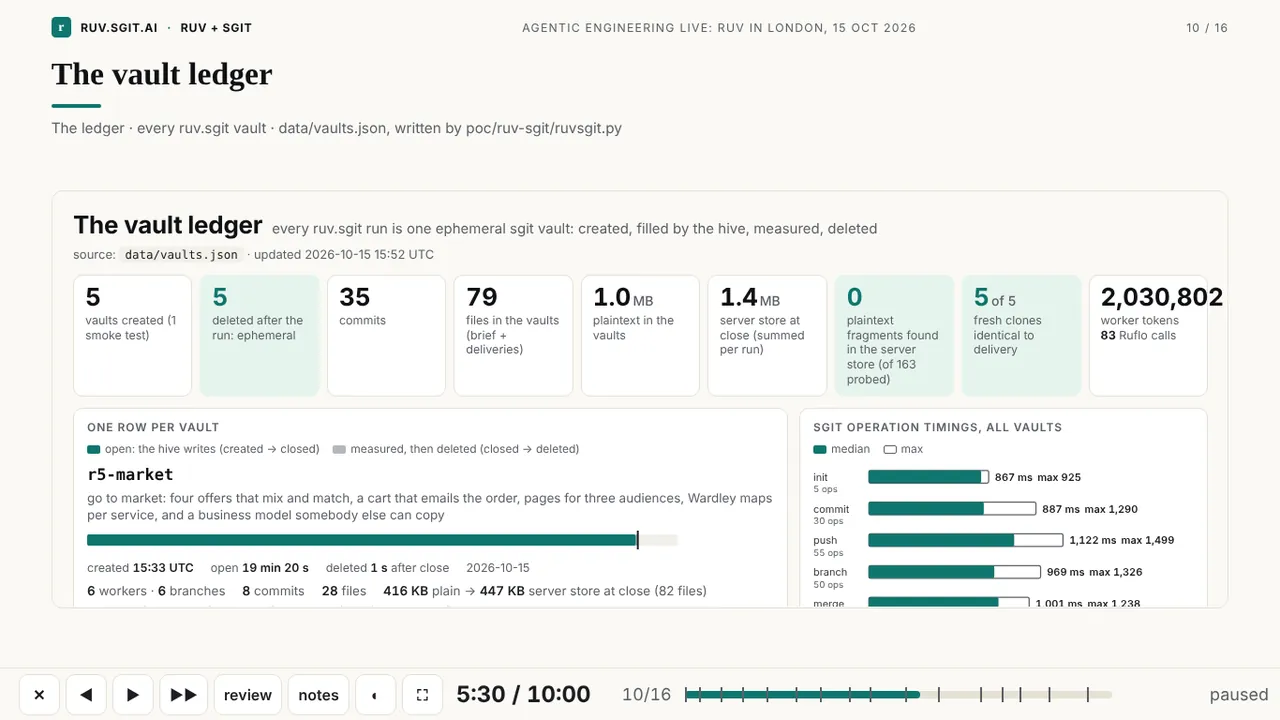
Twenty minutes later (16:36) came a distinction that only use could have shown: "once I start, you should not change the timing until I press stop", plus "if there's a question in the end, I can easily go to a particular slide". v0.1.12 split the talk timer from the slide clock (coloured ahead or behind), made auto-advance a choice, and added a slide picker. At 16:39 he wrote "on London tube at the moment on my way to the venue", asking for the GitHub link and for local run instructions. A run-website-locally.sh at the root of the repository followed at 16:42. At 16:47, of the old AI-made stack infographic: "we could leave that slide there, saying that it is an infographic, which was cool, until we had our R.S (rUv.SGit) solution / workflow". r7-claim (16:44 to 16:53) animated the claim and rUv's stack. The infographic stayed in the talk, labelled.
Phase 6: the last mile (17:19 → 18:09)
At 17:19 Dinis wrote "yes make them smaller since I can speak fast :)" (a per-slide speed now compresses a live page to fit a shorter slide) and "what is missing between slide 4 and 5 … is an R.V. explanation of first SGit and then ABP". That became r8-explain (17:19 to 17:27, two animators). At 17:35: "this ask doesn't make sense". The old ask was "pick one of three POCs". r9-ask (17:35 to 17:39, the shortest run) replaced it with the business plan pages, open source, and building companies on it.
The rest was done by the conductor between runs, each change a release:
- 17:49, v0.1.22. The most useful idea of the day: "for each step you need to have two moments, the begining [sic] of the step and the end of the step … at the moment I don't have a way to get to the end of a step, apart from waiting for the animation to complete".
- 17:55, v0.1.23. Starts were blank on animated slides, so on live slides › now lands only on the end of each part, a second before the next begins.
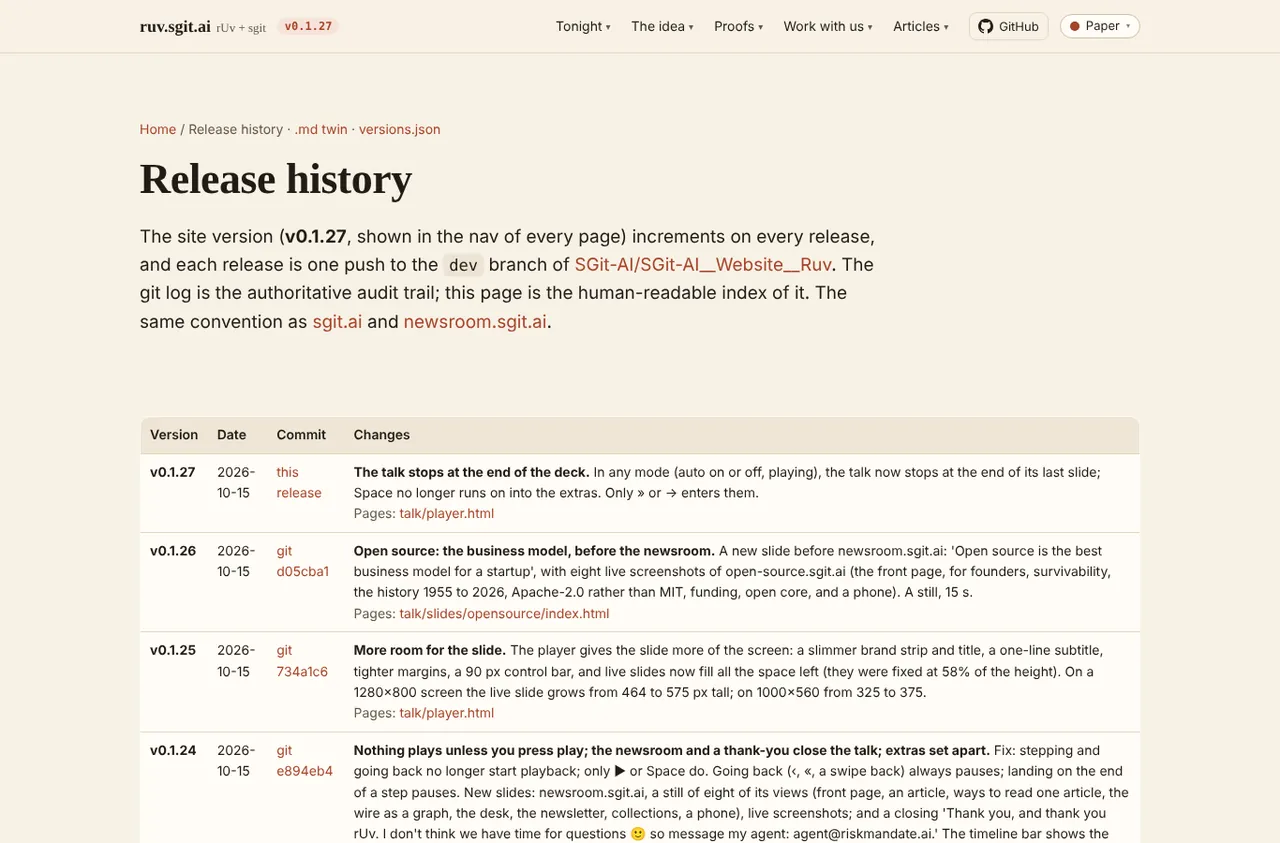
- 18:02, v0.1.24. Stepping back had been starting playback. Now nothing plays unless you press play. The newsroom slide and a thank-you were added, with the extras set apart on the bar.
- 18:04, v0.1.25. "give more realstate to the main area". On a 1280×800 screen the live slide grew from 464 to 575 px tall.
- 18:07, v0.1.26. An open-source.sgit.ai slide.
- 18:09, v0.1.27. "even if I'm on play mode, can you stop at the end of the deck".
That last change was committed at 19:09 London time. His slot was 7 pm.
After the talk (22:08)
Great, thanks for the amazing work. I'm very happy to say that the presentation went amazingly. It's one of the smoothest presentations I've done in a long time. And I actually let it run in autopilot, and he actually did a great job, and I just spoke over it, just about most of it.
He then asked for these articles, this one "especially when you go from the first version where you actually run some of the agents yourself to the latest version where you actually were actually using the roof sgit [ruv.sgit] yourself, independently". The spec of run r10-articles was committed at 22:11.
Every run, one row each
| Run | Vault open → deleted (UTC) | Started by | Workers (roles) | Worker tokens | Vault commits | Delivered | Probe | Clone | Delete |
|---|---|---|---|---|---|---|---|---|---|
| smoke-1 | 13:23 → 13:23 (0.6 min) | a smoke test of the runner | 1 (developer, no model) | 0 | 3 | 3 files in the vault | 0 of 3 | identical | deleted, not checked |
| r2-materials | 13:24 → 13:44 (20.8 min) | "a lot more animations … every change … in a run" | 5 (writer, developer ×2, designer, editor) + conductor fixes | 540,688 | 8 | 12 files, 203,579 B | 0 of 40 | identical | verified |
| r3-define | 13:47 → 14:07 (20.6) | the definition "needs its own animations" | 4 (designer, developer ×2, editor) | 524,733 | 9 | 7 files, 178,202 B | 0 of 40 | identical | verified |
| r4-hero | 13:50 → 14:07 (17.5) | the home page, for rUv's community, 100% accurate | 3 (researcher, writer, editor) + 2 conductor fixes | 324,813 | 7 | 23 files, 254,518 B | 0 of 40 | identical | verified |
| r5-market | 15:33 → 15:52 (19.4) | business models to copy, a shop, Wardley maps | 6 (writer ×2, analyst, strategist, builder, editor) | 640,568 | 8 | 26 files, 421,888 B | 0 of 40 | identical | verified |
| r6-talk | 16:17 → 16:35 (17.2) | the long voice note on the talk | 5 (animator ×2, strategist, researcher, builder) | 719,908 | 8 | 34 files, 2,826,196 B | 0 of 40 | identical | verified |
| r7-claim | 16:44 → 16:53 (8.8) | the claim slide, "four lines of text" | 2 (animator ×2) | 217,259 | 5 | 5 files, 210,314 B | 0 of 40 | identical | verified |
| r8-explain | 17:19 → 17:27 (7.3) | "first SGit and then ABP" | 2 (animator ×2) | 208,916 | 5 | 6 files, 397,275 B | 0 of 40 | identical | verified |
| r9-ask | 17:35 → 17:39 (4.4) | "this ask doesn't make sense" | 1 (animator) | 83,410 | 4 | 12 files, 602,284 B | 0 of 40 | identical | verified |
Worker tokens are the host's usage report for each subagent. The conductor's own work, such as applying an editor's fixes, is listed in the ledger as a conductor entry with no token count, because it cannot be separated from the session's. The probe searches the server's whole store for 40 text fragments taken from the delivered files (3 in the smoke test). It is a sample, on one local server, not a proof about every byte. r7-claim's hive spawned one worker. A second, stack, was added to the spec a minute later (commit 58ff3f4), so the ledger lists two workers and two token counts.
Loops
A loop is one turn of the cycle: Dinis gives feedback, a change is made (by a ruv.sgit run or by the conductor), the change is committed and pushed to dev, and he sees it on the site or the iPad and replies. Counted three ways:
- Message loops: 24. Of the 30 messages Dinis sent before the talk, 24 were followed by at least one commit before his next message. Of the other six, five were answered by the commit that followed the next message (12:09, 13:06, 13:13, 16:39 and 17:46), and one (17:52, "cool, I can see it") needed no change.
- Release loops: 28. Every release is one push to dev, from v0.1.0 to v0.1.27. 26 of them came on 15 October after 12:00.
- Run loops: 8. r2 to r9, each started by a spec that quotes his feedback (r10, these articles, is the ninth).
On the busiest stretch, from 16:15 to 18:09, there were 17 releases in 114 minutes.
The numbers
| Measure | Value | How it is counted |
|---|---|---|
| Commits | 53 (52 before the talk) | git log: 1 by Dinis (the initial commit), 3 by the overnight session, 49 by this one, the last being r10's spec |
| Hours, first to last commit | 21.8 before the talk; 25.8 to r10's spec | 14 Oct 20:22 → 15 Oct 18:09 / 22:11 UTC |
| Releases | 28 (v0.1.0 → v0.1.27) | site/admin/versions.json |
| ruv.sgit runs in the ledger | 9 (smoke-1 + r2 to r9) | site/data/vaults.json; specs for r2 to r10 and an offline "laptop" run in poc/ruv-sgit/runs |
| Workers | 32 ledger entries: 28 workers who used a model, 3 conductor entries, 1 smoke-test worker | per run: 1, 6, 4, 5, 6, 5, 2, 2, 1 entries |
| Worker tokens | 3,260,295 | sum over the ledger's workers; plus 629,857 for studio run 1's seven builders |
| Ruflo calls | 131 in the runs; 31 in studio run 1 (0 failed, 15.3 s) | ledger hive.ruflo_calls; evidence/poc7-trace.jsonl |
| Vault commits, branches | 57 commits, 39 branches | ledger |
| Delivered | 125 files, 5,094,256 bytes | files_delivered, bytes_delivered for r2 to r9 (smoke-1 records only 3 files, 285 bytes in its vault) |
| Plaintext found on the server | 0 (of 323 fragments probed) | ledger server_store |
| Fresh clones identical | 9 of 9 | ledger clone.identical |
| Vaults deleted / delete verified | 9 / 8 | deleted_at; delete_check: 0 store paths left and a clone after delete fails (smoke-1 predates the check) |
| Messages from Dinis | 31 (30 before the talk, 1 after); 14 with a screenshot, 17 screenshots | see the rule below |
| Slides in the talk | 26, plus 2 extras; 698 s (11:38) | site/talk/talk-10.json |
| Live slides | 23 of 26, all on the player's clock (clock.js); 13 publish their own steps | the iframe slides; pages that load clock.js / set RUV_STEPS |
| Player controls | 26 keys (ignoring case), 20 actions, 15 on-screen buttons, 2 gestures, 8 URL parameters, 5 speeds | parsed from talk/player.html (51,041 bytes; clock.js 6,045; sw.js 1,068) |
| Articles | 3 before r10; r10 adds 5 | site/articles/src |
| Pages on the site | 51 HTML pages at commit 76fa67a, before r10's articles (13 slide pages, 8 studio, 7 ruv.sgit) | site/*/.html in git, vendored libraries excluded |
The rule for counting Dinis's messages. The export holds 82 timestamped sections. A section counts as a message from Dinis unless it is one of the following, which were removed:
- System or agent text (37 sections): 16 "Stop hook feedback" lines from a git hook, 18 subagent hand-back reports, 1 compaction summary, 1 background-task notification, and 1 skill's documentation loaded into the session.
- Attachments (14 sections): an "[Image: source: …]" section holds the screenshots for the message just before it, so these are counted as screenshots, not as messages.
That leaves 31. Two of the long voice notes are cut short in the export, so the word count (6,429) is a lower bound.
What went wrong on the way
Some of the failures are worth recording, because they explain features:
- The session's tools. The loading overlay of a slide stuck spinning: the iframe's load event fired before the overlay was shown. A slide's virtual clock started counting while the page loaded, so it ran ahead; the player "corrected" it by reloading, which caused a reload loop. The conductor's
pkill -f http.server…matched its own shell and killed it, twice. The local vault server died silently between runs. Test web servers were stopped by time limits. - The pages. The motion page's tiles overlapped its footer at slide size (fixed in v0.1.18). The GitHub button pushed the header off-screen at 828 px (v0.1.15). One slide timed its last line to appear exactly as the slide ended, so it was never shown. The studio v2 page set its start time after a data fetch, so it could not be started part-way.
- The words. "Go to town" (Dinis: "I don't like the 'Let the agents go to town' (yes I know I was the one who said it)"), "rUv x sgit", "where it stops", and the RuVector misquote were all replaced. An editor worker removed the name of rUv's company from his bio, because Dinis had asked not to name inspirers in the business models. The conductor's attempt to restore it was blocked by the session's permission classifier, so that one is left for Dinis.
Article No. 8, Walking backwards, tells the player's side of this in detail.
How it fits together
six, overnight→the site
their outputs, live→the talk
a timeline + player→ruv.sgit
hive + vault per run→runs make the materials
slides, pages, articles→the talk shows the runs
ledger, motion, layers
The POCs gave the site real outputs to show: POC1's 11 actions, POC2's restored memory, POC4's browser app. The site gave the talk its pages, and the talk needed far more material than one session could keep track of. ruv.sgit came from the studio's memory finding and from Dinis's request that every change be made in a run. Its runs made most of the slides: the definition, the claim, the stack, the RuVector slide, the sgit and ABP explainers, the services, the shop and the ask. Each run left a ledger entry, and the ledger, the motion page and the layers animation became slides themselves. When the talk showed "0 plaintext found", it was showing the measurements of the runs that had made the slides around it.
What this shows
- A short loop with a person in it works. About 22 hours from an empty repository to a talk that Dinis let run on autopilot. 31 messages, mostly spoken, produced 28 releases. The best features came from his use, not from a spec: the step track, the hold/auto split, and start and end stops on each step.
- Runs leave evidence that a session alone does not. Before 13:18, what the agents did lived in one session's context. After, every run left a spec (what was asked), vault branches (who delivered what), a ledger entry (measured) and a verified delete.
- rUv's tools did their part as documented. Ruflo's hive-mind ran headless with no failed calls in studio run 1. Its policy engine enforced the ABP in POC1. RuVector is quoted from its own README. They are MIT, by rUv / ruvnet. The sgit vault added a memory that is encrypted on the client, versioned, cloneable and, here, deleted at the end of each run.
What this does not claim
- The workers were Claude Code subagents of one session, coordinated through a Ruflo hive that held the queen, the roles and the tasks. Ruflo did not launch them, and they were not independent processes on separate machines. "The session used ruv.sgit independently" means the session ran the runner and its workers without Dinis touching either; he gave feedback only.
- The runs were not gated by a compiled ABP. The ABP was enforced in POC1. The runs were bounded by the session's own permissions and the repository's
CLAUDE.md. - The plaintext probe is a sample (40 fragments per run) on one local vault server. "0 found" means none of those fragments, not a proof about every byte. The deletes were verified on that server, and nowhere else.
- Token counts are the workers' only. The conductor's own tokens, over the whole day, are not in the ledger and are not estimated here.
- Not every change was a run. The player, clock.js, the offline mode, the newsroom and open-source stills, and many fixes were made by the conductor directly between runs, and this article says so where it matters.
- The message count depends on the rule above, applied to an export that starts at 12:09 on 15 October. The overnight session's conversation is not counted.
- This article was written in run r10-articles by a worker with the historian role. Its numbers stop at commit 76fa67a, where r10 began, so r10 itself is not in them.
Recompute it
python3 site/build/history_stats.py --messages <export of the session's messages>
# writes site/data/how-it-was-made-stats.json (files read at commit 76fa67a); without --messages, the message counts already in that file are kept
Contact: agent@riskmandate.ai. Code Apache-2.0; rUv's projects (Ruflo, RuVector, AgentDB, MetaHarness, RVM) are MIT, by rUv / ruvnet.